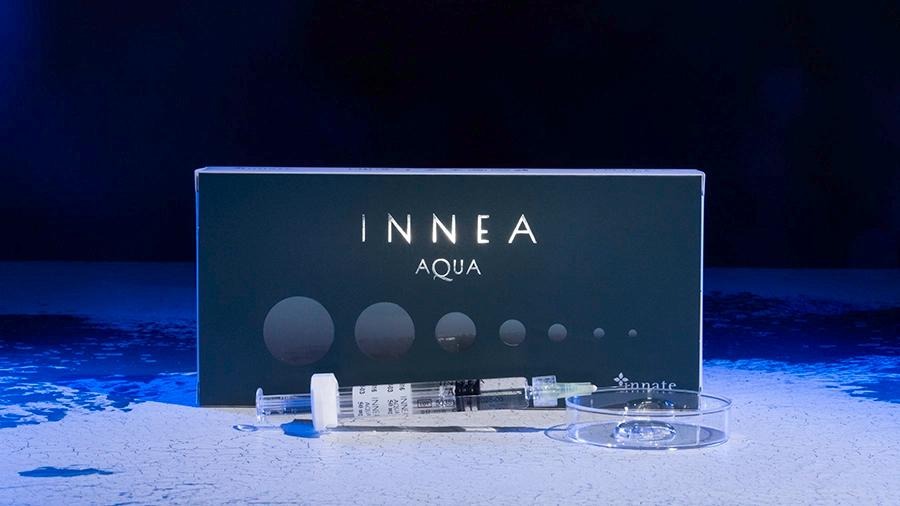
What does the evidence show for INNEA Aqua and similar HA treatments?
Read the evidence for INNEA Aqua and comparable injectable HA treatments, including measured hydration and skin-quality outcomes, formula differences and study limits.
If you are considering INNEA Aqua for rough skin, wrinkles or a superficial scar, you want to know whether it can make a worthwhile difference. The useful question is what has been tested, what improved and how closely that matches your concern.
INNEA Aqua uses hyaluronic acid (HA), a material that holds water, with trehalose, a sugar added to protect and stabilise the formula. Here we look at its registered uses in Singapore, tests of INNEA Aqua itself and patient studies of similar HA injections.
About this website: INNEA Aqua is an HA skin booster. Glo Pharma operates innea.com.sg and is its sole distributor in Singapore.

What is INNEA Aqua registered for in Singapore?
INNEA Aqua is registered with HSA for ageing and photoageing changes including roughness, reduced radiance and wrinkles, and for dermal repair after superficial skin trauma such as acne and chickenpox scars. The listed areas are the face, décolleté—the upper chest—and hands.
If a superficial scar is your concern, this puts INNEA Aqua into the discussion. Ask the doctor to identify the scar and explain how they would assess improvement. If roughness or wrinkles bother you most, agree which visible change you want to judge. Those are different outcomes, so the evidence below helps with different parts of that choice.
 INNEA Aqua tests
Research on the exact product
 Similar HA treatments
Patient studies of other products
 Laboratory research
How materials behave in the lab
Findings and limits belong together.
What have tests of INNEA Aqua found?
A manufacturer training presentation supplied to Glo Pharma describes two relevant laboratory tests:
- HA stability: a dual-weight HA formula with trehalose resisted an HA-breaking enzyme better than the comparison formula without trehalose. This supports the reason for adding the sugar.
- Cell repair: in a layer of human skin cells with a scratch made through it, cells exposed to INNEA Aqua closed the gap faster over 24 hours than the control cells. The illustrated test identifies INNEA Aqua lot 004806.
HA stability: how to read the table
Hyaluronidase is an enzyme that breaks down HA. The table compares two HA formulas: P8028 without trehalose and P7046 with 1% trehalose. T0 means the start of the test; T60 means 60 minutes later. MW and LW refer to the two sizes of HA chains in the formulas.
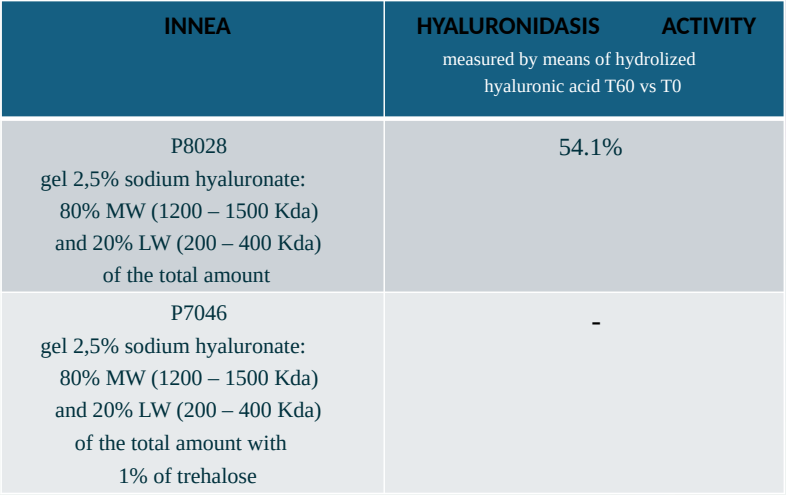
The table reports an enzyme-activity result of 54.1% for the formula without trehalose. It shows a dash for the formula with trehalose, rather than a numerical result. The dash should not be read as zero, and this table alone cannot tell us how much better that formula performed. It also does not measure how long a skin treatment lasts.
Cell repair: how to read the microscope images
The pale vertical strip is a gap deliberately scratched through a layer of skin cells. The test looks at how the cells fill that gap. In each pair, the control (comparison) sample comes first and the INNEA Aqua sample second. These are laboratory cells exposed to the product, not injected patients or photographs of treated scars.
At the start (T0): both samples show the scratch before the 24-hour observation period.
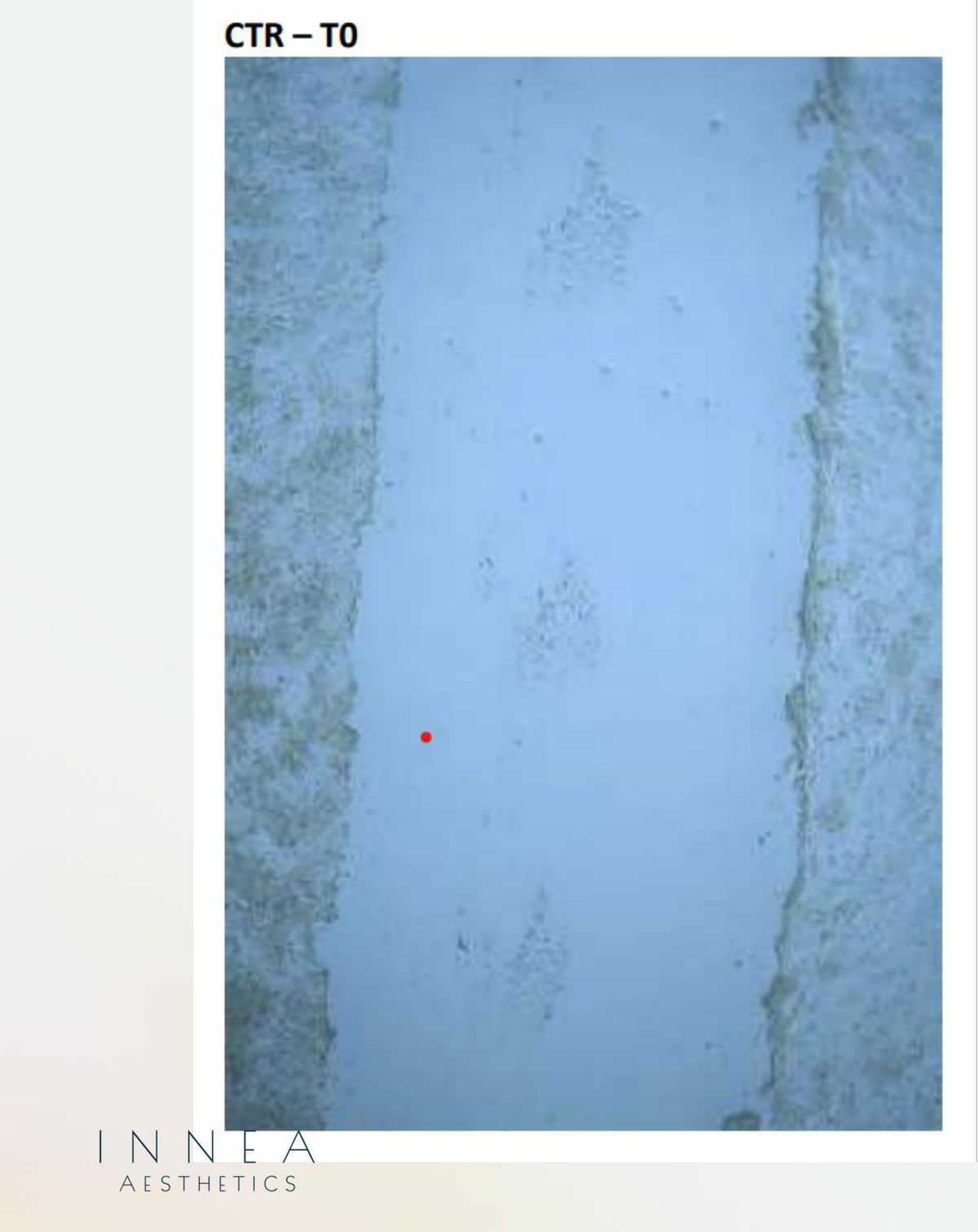
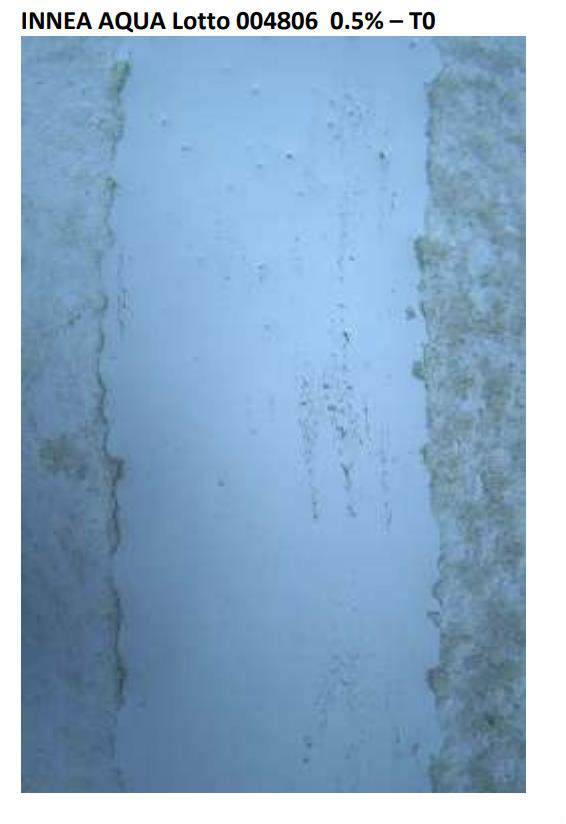
After 24 hours (T24H): the gap appears narrower in the INNEA Aqua sample than in the control.
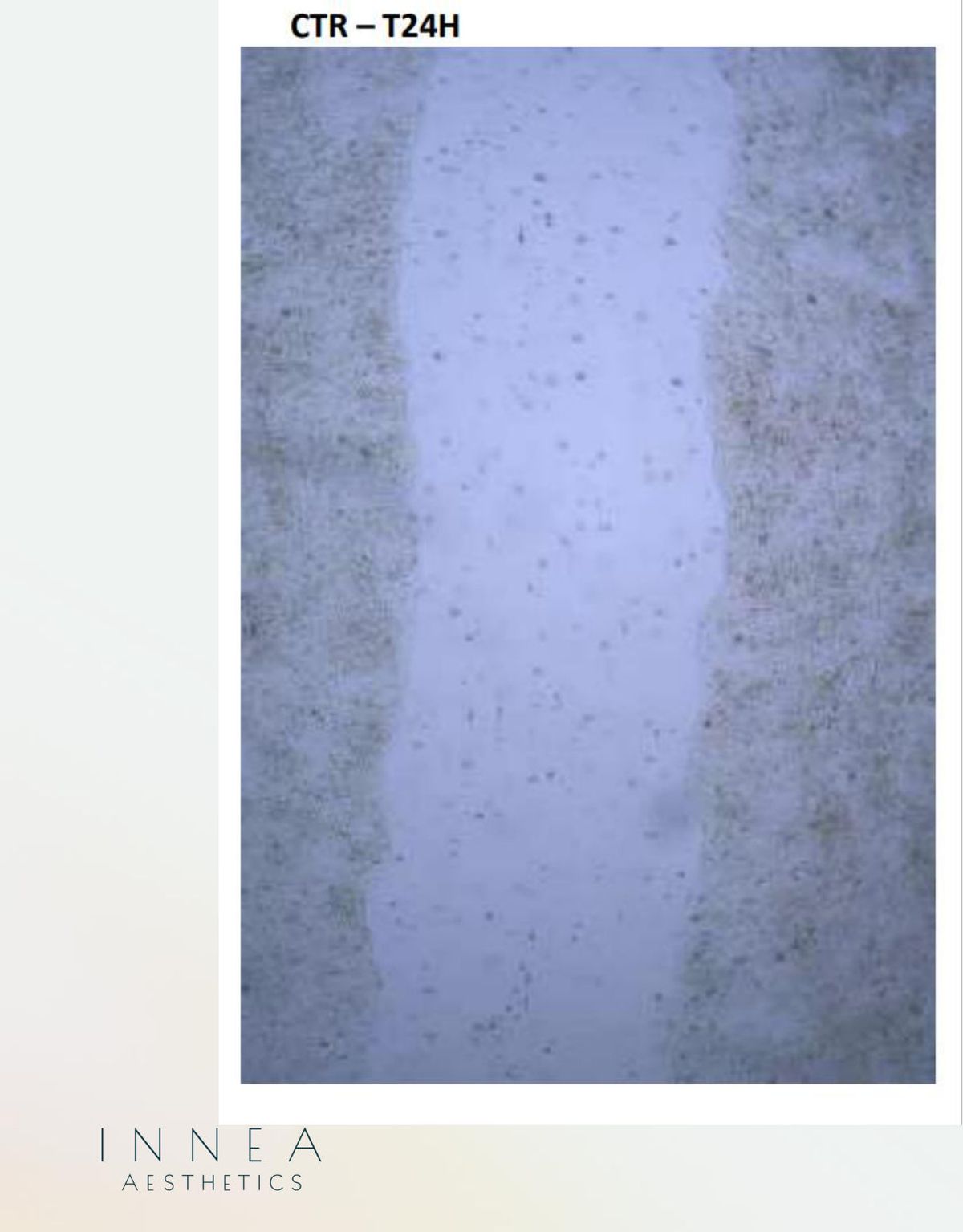
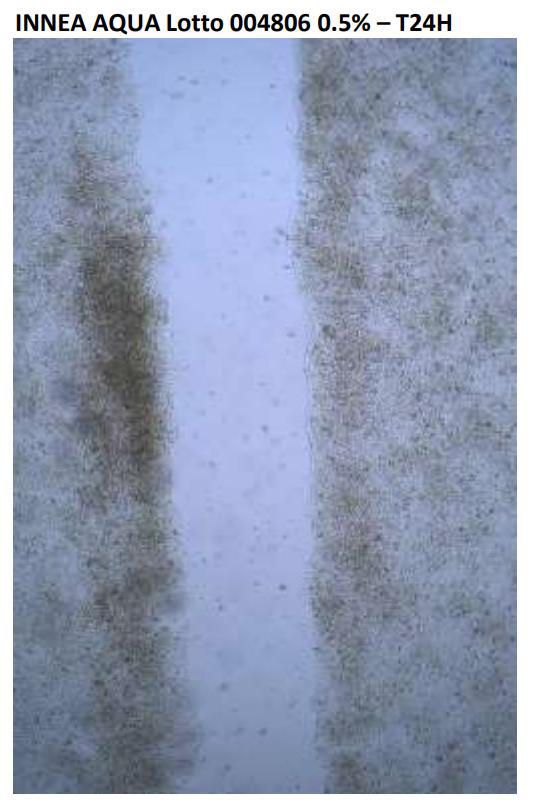
These findings help explain the formula's design and the interest in skin repair. They test the formula in a laboratory. To judge the amount of wrinkle or scar improvement, or how long it lasts, we need results from treated people.
A registered study of INNEA and INNEA Aqua plans to assess cheek and upper-chest wrinkles, skin appearance and feel, satisfaction and side effects after a course of injections. At our 12 October 2026 check, the registry had no posted results and we had not located a published results paper linked to the study.
What do patient studies of similar HA injections show?
Small amounts of HA injected into the skin are used to improve hydration and skin quality. INNEA Aqua uses linear HA: the chains are not chemically joined together through a process called cross-linking. Its study record describes 25 mg/mL of HA. The studies below test the same broad injection approach with different formulas.
A review of 13 studies reported improvements in hydration, radiance—how bright the skin looks—texture and elasticity. The individual studies show which changes were measured and when.
Patient study | What improved | What it helps you judge |
|---|---|---|
2023 HA-versus-saline study: 30 people, 28 completed; three sessions three weeks apart. The tested formula, M-HA 10, contained 10 mg/mL HA. | Ten days after the last session, measured hydration rose 35% on the HA side, compared with a fall of about 10% on the saline side. Radiance and some wrinkle measures also improved more with HA. | Supports an effect from HA beyond the injections alone. It gives a short-term hydration result; the manufacturer funded this small study. |
2026 trial in China: 448 adults; three full-face sessions four weeks apart, using a non-cross-linked HA solution. | Hydration, elasticity, roughness and fine-line scores improved more than in the routine-skincare group, assessed four weeks after the third session. | Adds evidence for short-term skin-quality benefits. It compared treatment with skincare, and participants knew which they received. The authors reported no funding or competing interests. |
Controlled study of 55 women: three monthly sessions of Glytone 1, a linear HA formula with glycerol and mannitol, compared with saline in the other cheek. | Three months after the last session, radiance was better on the HA side. The skin-stiffness measure did not show a clear advantage over saline then. | Shows why “skin improvement” needs to name the change: evidence for brighter-looking skin was stronger than for that measure of firmness. Pierre Fabre funded and conducted the study. |
Together, these studies support hydration and some skin-quality benefits from this HA approach. They tested other formulas overseas. They help explain the method, rather than provide a Singapore availability list or an exact prediction for INNEA Aqua. The ingredient and brand guide lists locally registered options.
What does the HA-and-trehalose research add?
A 2025 laboratory study tested another dual-weight HA-and-trehalose formula, Resteeme X. In human skin samples maintained outside the body, it reduced a marker of sugar-related protein damage by about 61–69% under experimental stress. The distributor funded and participated in the study.
This supports further research into the ingredient combination. It tests a different finished product, so it sits alongside the INNEA Aqua formula tests rather than replacing them.
How can you use the evidence to decide?
For dryness, roughness and fine lines, comparable HA patient studies give a useful basis for discussing skin-quality treatment. For a superficial scar, INNEA Aqua's HSA registration and cell-repair test are relevant starting points; ask the doctor about their experience with the same scar type and how they will measure the change.
For lifting or a combined treatment, ask what improvement each part of the plan is meant to deliver. Your doctor's experience with the same product, area and concern can help set expectations alongside the research. The treatment-choice guide separates smoother skin, lost volume and lifting.
The question to bring into the appointment is: “For the change I care about, what improvement do you expect, and when will we review it?” Then weigh that likely benefit against the cost and recovery. Our results and maintenance guide helps with later visits.
Sources and references
Regulatory recordINNEA Aqua
Trial recordINNEA Aqua
INNEA and INNEA Aqua — registered clinical study (NCT07331181)
Scientific paperRelated treatments or formulations
Scientific paperRelated treatments or formulations
Scientific paperRelated treatments or formulations
Scientific paperRelated treatments or formulations
Scientific paperRelated treatments or formulations